
Our Work
Field-based research, education, and partnerships advancing wildlife conservation and resilient landscapes across the Borderlands.
Modelling Black Bear Populations in the Trans-Pecos, Texas

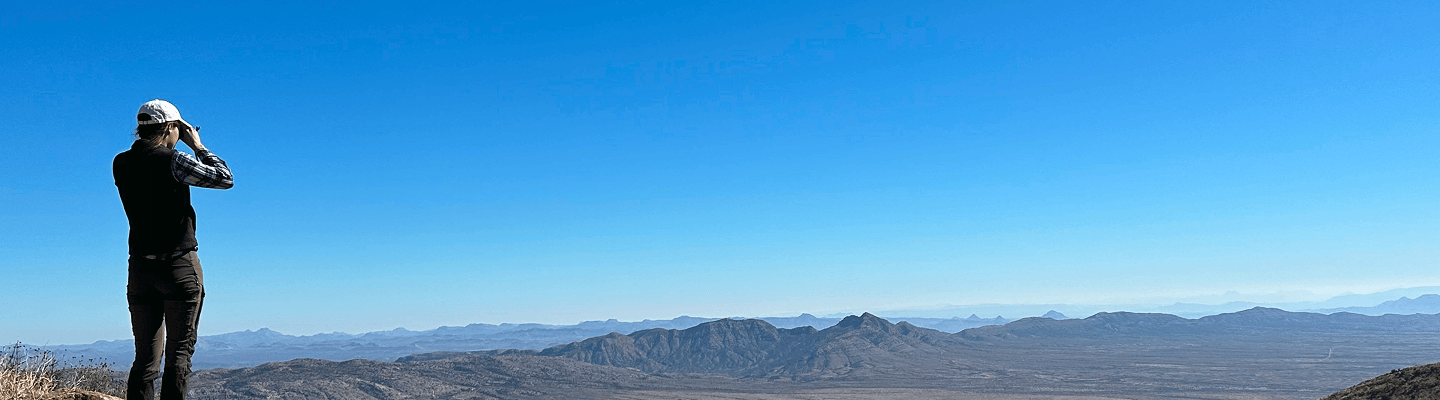
The Trans-Pecos region of western Texas mainly consists of desert shrub/grasslands with patches of higher-elevation (1,500–2,000 meters) mountain ranges. These higher, more isolated areas are more favorable for many species, including American black bears, which prefer these areas to the Chihuahuan Desert floor. It is believed that by 1950 black bears were extirpated from the Trans-Pecos region; however, populations to the south in the mountains of northern Mexico survived.
During the 1980s, park officials in Big Bend National Park reported the return of black bears to the Trans-Pecos with the confirmed sighting of a breeding sow with cubs within the park. This return marked the beginning of the natural recolonization of black bears in the Trans-Pecos.
Black bear populations within the Trans-Pecos region of Texas have been classified as a mainland-island metapopulation. In this model, the larger population in Mexico (the “mainland” population) feeds into other subpopulations in the mountain ranges of the Trans-Pecos (“island” populations), which in turn can then feed into other populations. Based on previous studies of bear populations in Big Bend National Park and Black Gap Wildlife Management Area, we created a metapopulation model for the region, which simulates movement between these “mainland” and “island” populations. Using this model, we estimated local carrying capacity (the population size that the environment can sustain) for each subpopulation, as well as immigration from Mexico and the rate of dispersal from Black Gap Wildlife Management Area to the Davis Mountain region.
Black bears in southwestern forests make use of a relatively low number of vegetation species compared to their northern counterparts. This makes the bears more susceptible to decreases in reproduction during years when those vegetation species are less productive. Because black bears have a long delay from birth to adulthood, we believe it is for this reason that the modelled overall population average within each subpopulation stayed relatively close to the low-end carrying capacity value.
We used the model to evaluate several possible scenarios (such as recovery time) that would be needed after complete extirpation from the Trans-Pecos region. Black Gap Wildlife Management Area showed an average of 7 years, while both Big Bend National Park and the Davis Mountain region had an average recovery time of more than 14 years. While these numbers are only estimates, they help us understand why bears’ natural recolonization process will take considerable time due to the population dynamics of the species (survival, reproduction, dispersal) and the fluctuations in available resources in the Trans-Pecos.


