
Our Work
Field-based research, education, and partnerships advancing wildlife conservation and resilient landscapes across the Borderlands.
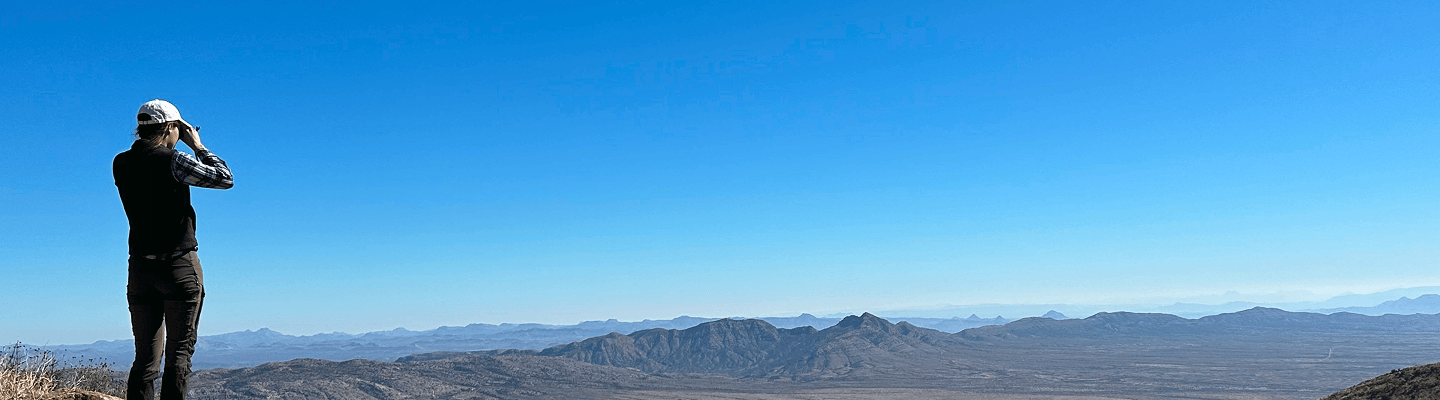
Estimating Abundance of Black Bears and Mountain Lions Using Camera Surveys in West Texas

Jamie Cooper, Patricia Moody Harveson, Dana Karelus, and Louis A. Harveson
Large carnivores act as keystone species, playing an essential role in maintaining the balance of ecosystems. Estimates of large carnivore population sizes are useful not only for their management, but also for management of their prey species.
Difficulties arise when studying these carnivores — they are often elusive, few in number, and have large ranges — but ever-evolving methods that use remote cameras and spatial data may provide practical options for estimating populations. Limited research on the population estimates of large carnivores in West Texas has been published.
This study evaluates the use of camera surveys to estimate the abundance of black bears (Ursus americanus) and mountain lions (Puma concolor) in the Davis Mountains. We established a 342-km2 grid with 36 remote cameras to survey for these species. Cameras were placed at baited sites on likely travel corridors, such as mountain saddles and game trails. We surveyed for two 12-week periods (summer 2018 and spring 2019) and collected approximately 835,000 photographs. In summer 2018, we collected 9 independent photos of mountain lions and 25 independent photos of bears. In spring 2019, we collected 39 and 21 independent photos of mountain lions and black bears, respectively.
These photos help us estimate abundance and evaluate the use of camera surveys for monitoring large carnivore populations in West Texas. These results will be useful for conservation and management specialists interested in non-invasive techniques for acquiring population estimates.
Funding sources: Welder Wildlife Foundation, Horizon Foundation, Summerlee Foundation, and study site access from The Nature Conservancy.


