Our Work
Field-based research, education, and partnerships advancing wildlife conservation and resilient landscapes across the Borderlands.
Assessing Eyeworm and Cecal Worm Infestations in Quail Throughout the Trans-Pecos Region of Texas
Rachel E. Bittner, Ryan S. Luna, Ryan O’Shaughnessy, and Dale Rollins
Quails throughout the Trans-Pecos are experiencing population declines due to various anthropogenic influences. Currently, little is known on how parasites might be contributing to the decline of endemic quails in the region.
An experiment was conducted for Gambel’s quail (Callipepla gambelii), Montezuma quail (Cyrtonyx montezumae), and scaled quail (Callipepla squamata) to assess:
- the relationship of eyeworm and cecal worm infections to desert quail age and sex cohorts
- influences of precipitation on eyeworm and cecal worm loads
- associations of supplemental feed on eyeworm and cecal worm loads in scaled quail
Quail were collected from 21 properties throughout the Trans-Pecos ecoregion from September 2018 to July 2020. Totals of 650 scaled quail, 14 Gambel’s quail, and 5 Montezuma quail were collected using donations, funnel traps, and shotgun harvest.
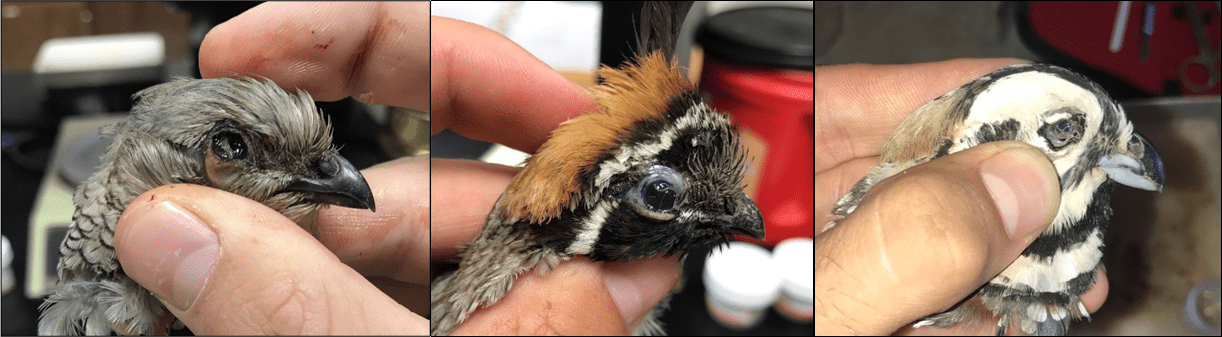
Top variables influencing eyeworm abundance were sex (of quail), season (of collection), and the interaction of the two variables. The top variables influencing cecal worm abundance were age (of quail) and sex (of quail). Seven of the 14 Gambel’s quail had eyeworms (8.14 ± 4.60), while all 14 had cecal worms (75.57 ± 28.10). All five Montezuma quail had eyeworms (12.50 ± 1.50) and cecal worms (38.25 ± 18.63).
Eyeworm prevalence, abundance, and intensity were not statistically significant between wet and dry regions in the Trans-Pecos (p = 0.012). Still, cecal worm loads were significantly different (p = 0.036), with loads increasing at wet regions. Eyeworm loads were not significantly different between supplementally fed and non-fed sites (p = 0.087). However, cecal worm loads were significantly different, with loads increasing at supplemental fed sites (p ≤ 0.001).
Investigating parasite prevalence, abundance, intensity, and their relationship with precipitation and food sources in the Trans-Pecos is an essential step in evaluating how these parasites may be impacting health, reproduction, and survival of the quails.
Funding source: Park Cities Quail Coalition.