Update on New World Screwworm and Other Wildlife Diseases in Texas
Trans-Pecos Wildlife Conference 2026
Aug. 6, 9:20 am Session
From New World screwworm to chronic wasting disease, wildlife diseases pose an ongoing challenge for wildlife managers across the Trans-Pecos.
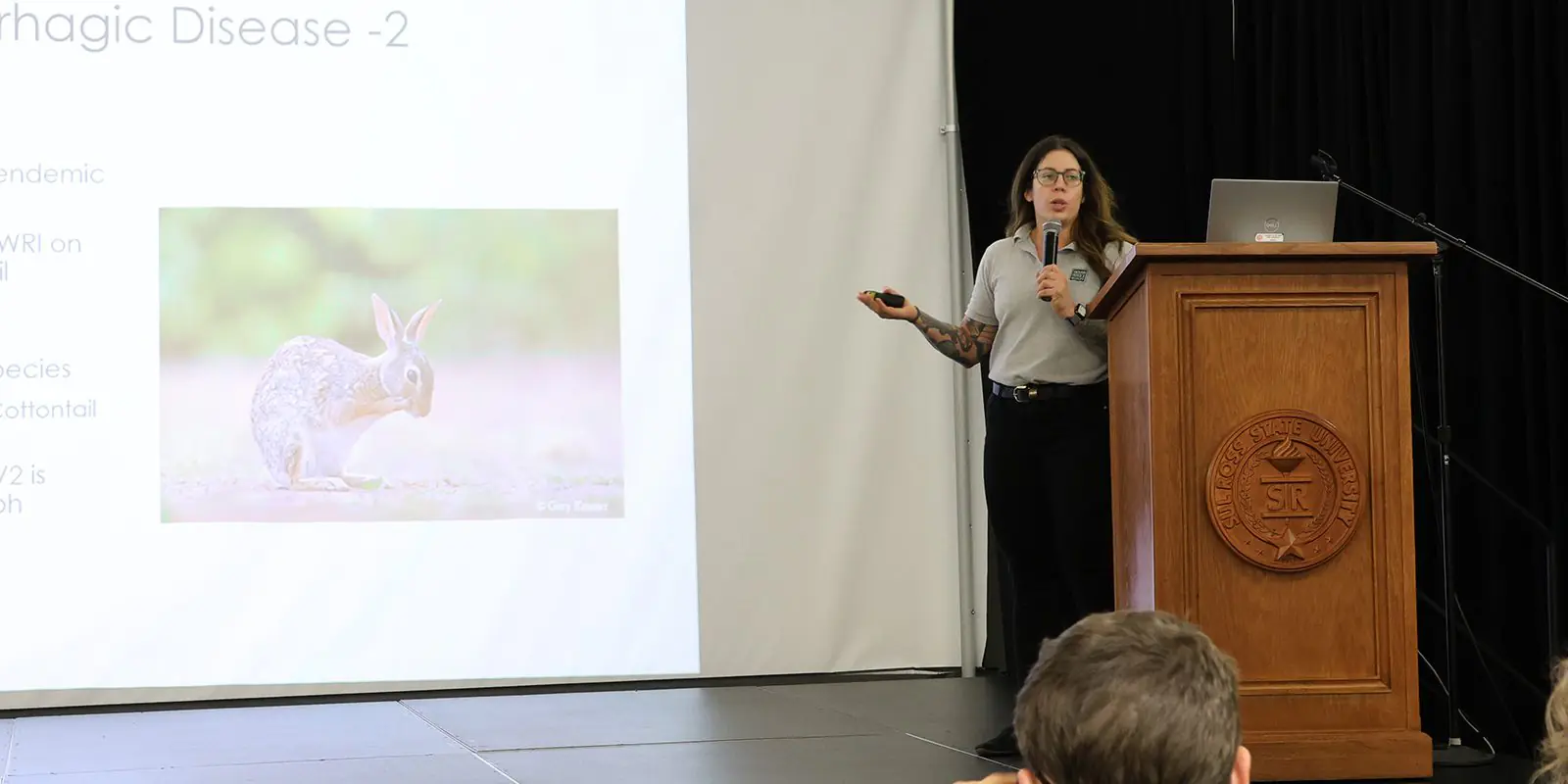
Dr. Sara Wyckoff, one of two wildlife veterinarians with the Texas Parks and Wildlife Department (TPWD), provided an update on several diseases being monitored in West Texas, including Mycoplasma ovipneumoniae, chronic wasting disease, rabbit hemorrhagic disease and New World screwworm.
Wyckoff began with Mycoplasma ovipneumoniae, commonly known as M. ovi, a bacterium associated with respiratory disease in bighorn sheep. The bacterium is commonly carried by domestic sheep and goats and can be transmitted to wild bighorn sheep.
TPWD continues extensive surveillance for the disease, testing bighorn sheep and aoudad whenever animals are handled and expanding monitoring into additional mountain ranges. Elephant Mountain Wildlife Management Area and the Franklin Mountains continue to serve as clean herds.
“We really want to see all of the different landscapes out there and the story that they are telling when it comes to Mycoplasma,” Wyckoff said.
Researchers are also studying the genetic strains of M. ovi found in Texas bighorn sheep and aoudad. Understanding those differences is particularly important when considering moving bighorn sheep between populations, because introducing a new strain could increase disease risk.
Wyckoff said relatively little research has been conducted on disease in aoudad, making the work in Texas especially valuable.
“We’re really doing some groundbreaking things here by collecting this data from aoudad, sending it in for strain typing and seeing, are they matching the bighorn sheep strains?” she said.
Another recent investigation demonstrated how complicated diagnosing wildlife disease can be. Landowners began reporting aoudad with cloudy, painful-looking eyes and others that appeared to be circling. Testing initially identified infectious keratoconjunctivitis, or infectious pink eye, which can be spread by flies.
However, animals with normal-looking eyes were also exhibiting neurological symptoms. Additional investigation found heavy concentrations of nightshade in the rumen of some affected aoudad. Ultimately, researchers determined that two separate problems were occurring at the same time: infectious pink eye and plant toxicity.
“It was really great cooperation between biologists and landowners, finding out who was seeing these cases, when, and helping us get to those animals quickly so we could get these important diagnostic tissues,” Wyckoff said.
She also provided an update on chronic wasting disease (CWD). TPWD and research partners are monitoring interactions among elk, white-tailed deer and mule deer in areas where CWD has been detected, including the Hueco Mountains and the Panhandle. Hundreds of animals have been collared to track their movements and investigate mortalities. Wyckoff encouraged hunters to continue submitting samples for voluntary CWD testing.
“Every little bit of information is information that we can gain knowledge from,” she said.
Research is also underway on rabbit hemorrhagic disease virus, or RHDV2, which has been present in Texas since 2020. TPWD is partnering with the Caesar Kleberg Wildlife Research Institute on research involving the Davis Mountains cottontail, including work to determine whether vaccination could help protect vulnerable rabbit populations. Researchers are also assessing the cottontail’s population status and studying why susceptibility to the disease varies among rabbit species.
Wyckoff saved the issue receiving perhaps the most attention for last: New World screwworm.
The parasitic fly lays eggs in wounds or body openings of warm-blooded animals. Once the eggs hatch, the larvae feed on living tissue. Even something as small as a tick bite can provide an entry point, and severe untreated infestations can kill an animal.
The screwworm life cycle can be completed in as little as 21 days, making early detection particularly important.
“We really rely on you guys and everybody else out there to tell us when you see any of these maggots in any animals,” Wyckoff said. “We need to stop them, pull them out and do what we need to with the animal or the carcass, and stop them from turning into a pupa, which can then turn into mating flies.”
At the time of the conference, Wyckoff reported 45 active cases and noted that infested zones extended into the Big Bend area, including Elephant Mountain. No detections had been documented in wildlife.
TPWD is working with the Texas Animal Health Commission, U.S. Department of Agriculture, U.S. Fish and Wildlife Service, Texas Division of Emergency Management and other partners on the response. Surveillance includes work on the ground as well as drones, trail cameras, fly traps and reports from the public. USDA is also responsible for dispersing sterile flies, a key tool for controlling screwworm populations.
Wyckoff closed with a straightforward message for landowners, hunters and others who spend time on the landscape: watch wildlife and livestock closely and report anything suspicious immediately.
“Early detection is key,” she said. “You can’t ever let us know too soon. We’d much rather respond to a negative maggot than miss out on a positive one.”
Sponsors and Organizing Partners
The 2026 Trans-Pecos Wildlife Conference brought together a collaborative team of organizing partners, including the Borderlands Research Institute at Sul Ross State University, Texas Wildlife Association, and Texas Parks and Wildlife Department.
The conference was made possible through the generous support of our sponsors: Dixon Water Foundation, ConocoPhillips, Corteva Agriscience, Alligare, No Big Bend Wall, and the Center for Big Bend Studies. We sincerely thank our sponsors for their commitment to advancing wildlife conservation and stewardship in the Trans-Pecos region.