Change at the Border: Voices from Conservation, Science, and Policy
Trans-Pecos Wildlife Conference 2026
Aug. 6, 8:20 am Session
“If Texas had a cathedral, it would be the Big Bend, without a doubt.”
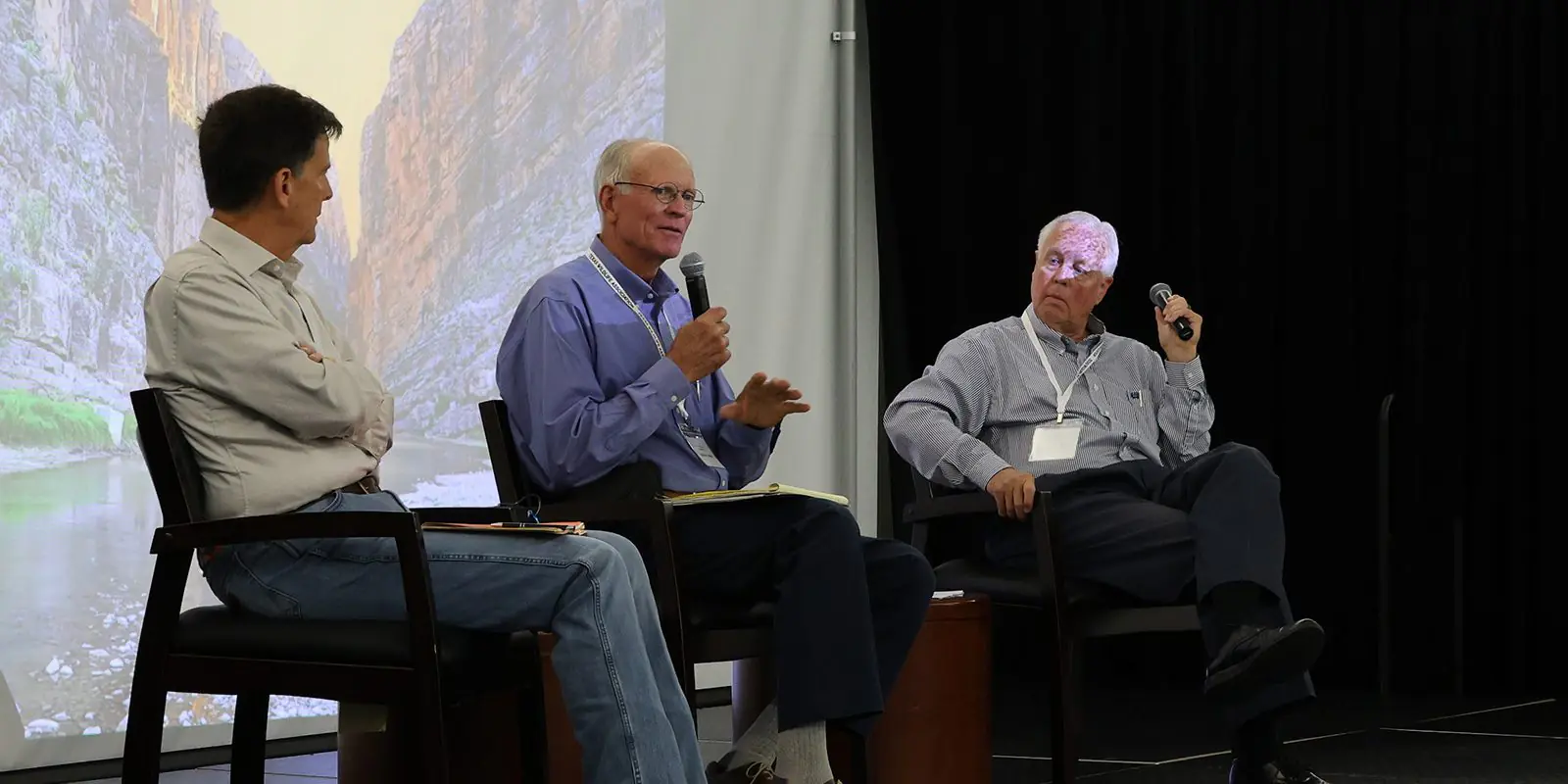
With those words, attorney Jim Bradbury helped set the stage for a wide-ranging discussion on proposed border infrastructure in the Big Bend region and what it could mean for wildlife, landowners, local communities, and one of the most remote landscapes in the country.
“People revere this place,” Bradbury said. “And it is certainly under threat.”
The discussion served as the keynote session of the 2026 Trans-Pecos Wildlife Conference, held August 5-7 at Sul Ross State University. The quadrennial conference brings together landowners, wildlife professionals, researchers, and conservationists to explore emerging issues in the region, wildlife research and management, applied management, and land stewardship.
Hosted by the Borderlands Research Institute, Texas Wildlife Association and the Texas Parks and Wildlife Department, the conference featured a full day of educational sessions along with field-based learning opportunities.
Bradbury was joined by Brewster County Judge Greg Henington and Raymond Skiles, a retired wildlife biologist who spent 30 years at Big Bend National Park and whose family owns property along the Rio Grande. Both of them made it clear from the beginning that the debate is not about whether the border should be secure; it is about whether large-scale physical barriers and associated infrastructure make sense in a place where geography itself presents a formidable obstacle.
“Everybody in this room knows that the country itself is a wall,” Henington said.
Henington said he initially hoped local officials would have an opportunity to sit down with federal decision-makers and discuss alternatives that could provide border security while protecting the park and surrounding communities.
“We know this country better than anybody flying in from Washington,” he said. “How about a little dialogue?”
Instead, Henington said, local officials have struggled to get a clear picture of what is planned.
“We were hoping that they would roll out a plan. Whether we like that plan or not, ‘Here’s our plan, here’s what we’re going to do,’” he said. “And yet what we have been finding is that we’re getting it in little pieces.”
Henington said the lack of a clear plan and meaningful dialogue is taking a toll on people who live and work in the region.
“We’re spending way too much time on this topic, and our folks are not focusing on their businesses and their livelihoods,” he said. “They’re having to fight their own federal government on this issue. And we can’t even get our own federal government to sit down at the table and discuss it.”
Skiles’ background provided both a wildlife biologist’s and landowner’s perspective to the conversation. His family has owned property near Langtry for generations, and he said he has received letters from the Department of Homeland Security telling him to negotiate an agreement or face the federal government taking property for construction.
He also described a long history of cooperation between Big Bend National Park and Border Patrol. When he first worked at the park, Border Patrol agents were neighbors and colleagues who knew the area and worked closely with park staff. Even during periods of increased illegal crossings, he said, the Big Bend region represented a small fraction of activity along the entire U.S.-Mexico border.
“It’s not the locals that are driving the border wall issue,” Skiles said.
A central concern for Skiles is the waiver of federal environmental laws that ordinarily require analysis and public input before projects move forward. Among them are the National Environmental Policy Act, Endangered Species Act, Clean Water Act, Wilderness Act and Wild and Scenic Rivers Act.
“I even kind of hate to use that term,” Skiles said of the word “waived.” “‘Ignored’ is what it allows. You don’t have to think about it.”
Skiles acknowledged that environmental review can be cumbersome but said his years with the National Park Service taught him its value.
“I think all of us have been frustrated sometimes with the bureaucracy, making it hard to get things done,” he said. “But frankly, I’m proud that we would go to the public.”
The consequences of bypassing that process become especially significant for wildlife. Skiles said an earlier proposal called for a 30-foot steel bollard wall that would have blocked movement for black bears, mule deer, desert bighorn sheep and other species. Pushback from conservation organizations, wildlife professionals and others helped move portions of the Big Bend proposal toward lower vehicle barriers.
That is an improvement, Skiles said, but those barriers still come with roads, cleared land, lighting, power, fiber optics and other infrastructure. The disturbance itself could destroy habitats and provide new footholds for invasive plants.
Wildlife connectivity is another concern. Black bears recolonized Big Bend from Mexico and continue to move between mountain ranges on both sides of the border, particularly during difficult years.
“The most important thing for their future is to have more populations in the mountains on both sides of the border,” Skiles said.
Henington asked the audience to consider the impact of the infrastructure not only on wildlife but also on the Big Bend experience. He described floating toward Santa Elena Canyon today through a landscape that offers one of the most remote wilderness experiences in the Lower 48. Under current plans, he said, visitors would instead encounter a road and barrier running along the river before reaching the canyon. Skiles then noted that this area had one of the lowest border crossing numbers along the bottom of the United States.
“If we had a million people moving across the border and we couldn’t stop it, that might be a different issue, but we don’t,” Henington said. “So, we’re going to build a lateral road along the river in the floodplain, and we’re going to put a four- to six-foot-high top rail fence…and we’re going do that for what reason?”
The potential impact on the Rio Grande floodplain was brought into even sharper focus during audience questions. When asked about ongoing land clearing near Santa Elena Canyon, Skiles stressed the ecological importance of the area.
“That is not the dry desert with cactus,” he said. “It is riparian environment. That’s the highest value wildlife habitat that we’ve got.”
Both speakers pointed to surveillance technology, drones and other tools as potential alternatives to physical barriers. And both said public engagement still matters.
“The decision-making is in Washington,” Henington said. “They’re the ones that need to hear from us.”
Despite the frustration expressed throughout the session, Henington concluded with determination.
“Our foot is not off the gas on this issue,” he said. “We’re going to continue to keep our foot on the gas until we get some resolution to this.”
Sponsors and Organizing Partners
The 2026 Trans-Pecos Wildlife Conference brought together a collaborative team of organizing partners, including the Borderlands Research Institute at Sul Ross State University, Texas Wildlife Association, and Texas Parks and Wildlife Department.
The conference was made possible through the generous support of our sponsors: Dixon Water Foundation, ConocoPhillips, Corteva Agriscience, Alligare, No Big Bend Wall, and the Center for Big Bend Studies. We sincerely thank our sponsors for their commitment to advancing wildlife conservation and stewardship in the Trans-Pecos region.