Session II: Big Game Management and Research
Trans-Pecos Wildlife Conference 2026
Aug. 6, 10:55 am Session
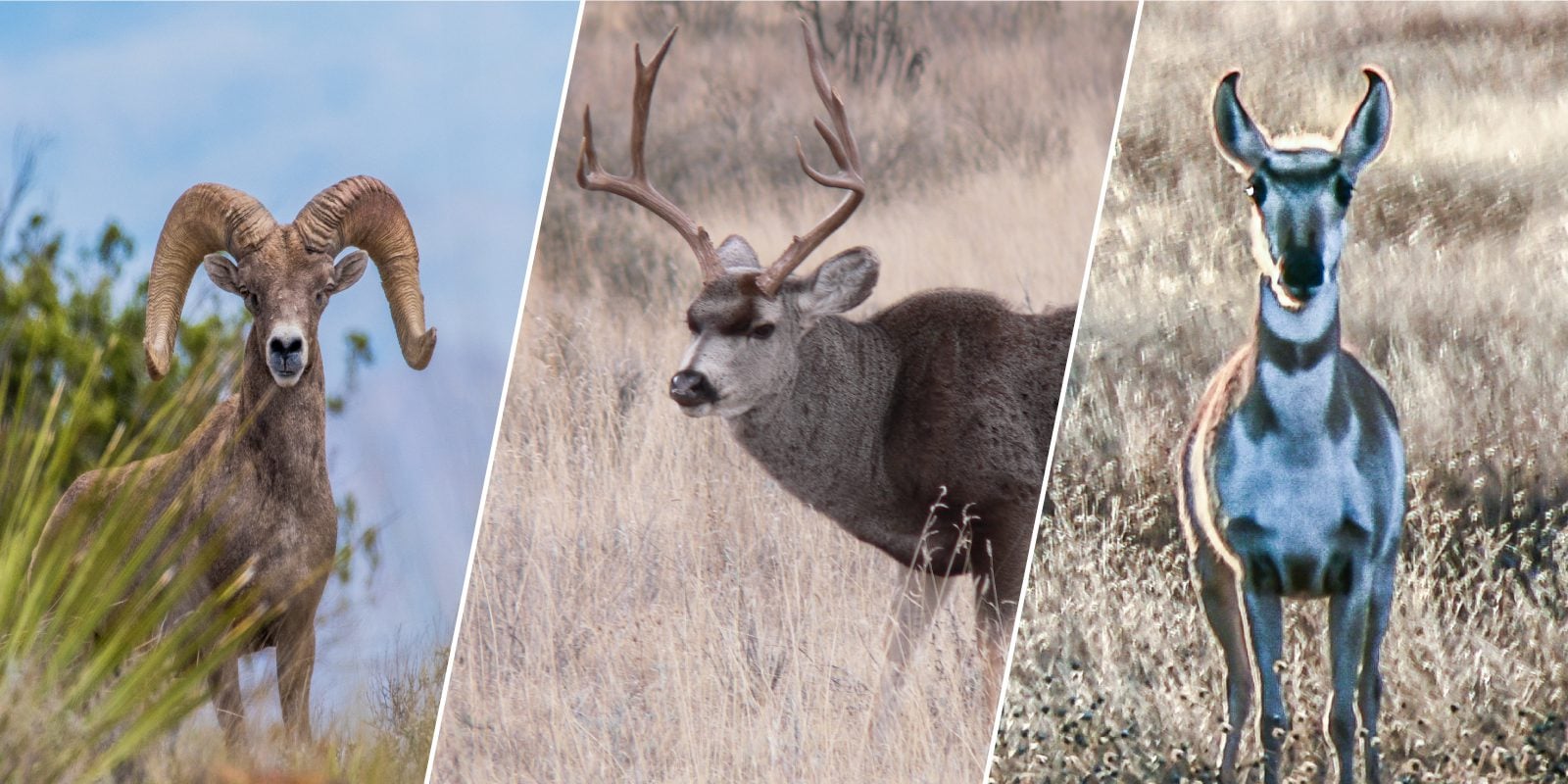
From declining mule deer numbers to the continuing challenges facing desert bighorn sheep, researchers and wildlife managers are working to better understand what is happening with big game populations across the Trans-Pecos and what can be done about it. Four presentations explored population trends, new tools for understanding pronghorn habitat, the future of desert bighorn restoration, and what researchers are learning about managing growing aoudad populations.
Trans-Pecos Mule Deer and Pronghorn Population Update
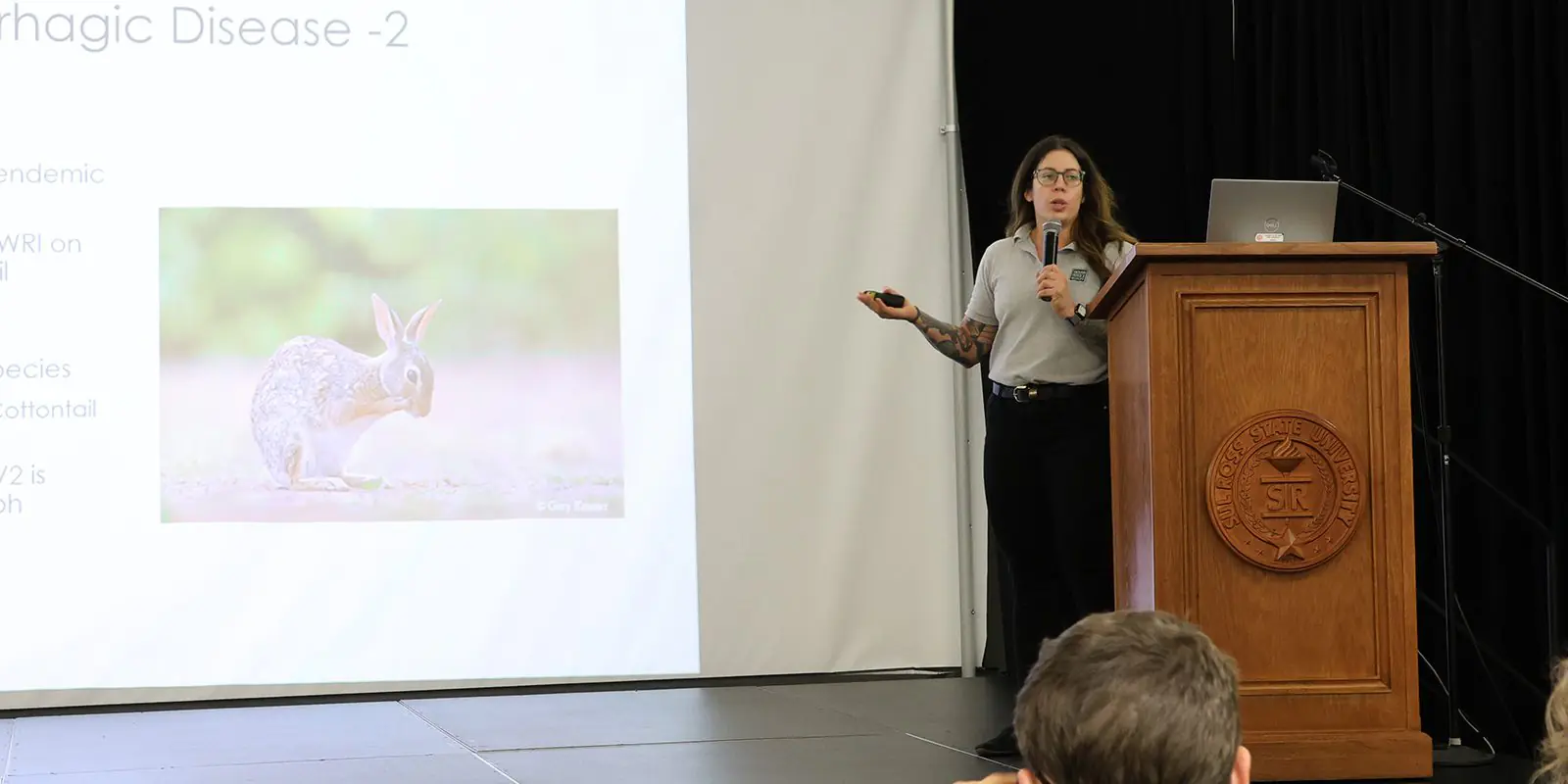
Shawn Gray, Mule Deer and Pronghorn Program Leader with the Texas Parks and Wildlife Department, opened with a look at two of the Trans-Pecos’ signature big game species, and the news was decidedly mixed.
Mule deer numbers have been trending downward since 2011. The 2024 population estimate was the lowest in the trend Gray presented, and for the first time, the agency estimated more mule deer in the Texas Panhandle than in the Trans-Pecos.
“It’s good for the Panhandle, bad for the Trans-Pecos,” Gray said.
Drought remains a major driver, but Gray also pointed to brush encroachment, growing aoudad and elk populations, and increased predation. Fawn production has remained relatively stable, but not at levels high enough to reverse the decline.
Harvest was not the culprit. Gray said Trans-Pecos landowners remain conservative in their mule deer harvest, with an average of 2.4 does per buck observed during post-season surveys and an average harvested buck age of 5.4 years; all are great indicators of a very conservative harvest strategy.
The pronghorn story is more encouraging. Since 2017, populations have remained relatively stable, with fawn production increasing in the face of historic drought. Gray credited extensive habitat work, fence modifications/replacement, predator management, and outstanding partnerships with landowners and conservation organizations.
“We’re at least maintaining what we have,” he said, “and we’re not losing numbers like what we see in our mule deer herds.”
ProngMap: A Tool for Understanding Change and Prioritizing Management of Pronghorn Habitat
Dr. Justin French of the Borderlands Research Institute offered a first look at ProngMap, an interactive tool being developed to help landowners and wildlife managers understand how pronghorn habitat has changed over time and where management can make the greatest difference.
The project combines an enormous body of GPS data with decades of satellite imagery. Researchers have amassed 2.83 million GPS locations from 537 individual pronghorn over 16 years. They can pair that information with Landsat satellite data dating back to 1985.
The result allows researchers to follow what French called the “green wave,” the changing patches of high-quality forage pronghorn seek following rainfall.
“In West Texas, it’s not driven by temperature; it’s driven by scattered rainfall, so it’s really more of a green splatter than a wave,” French said.
Early results show substantial variation across the landscape. On the Marfa Plateau, for example, researchers found that the western portion has experienced the greatest loss in productivity during peak habitat conditions.
ProngMap is expected to launch next year. Users will be able to enter a ranch, pasture, herd unit, or other area and see how habitat has changed. Future versions are planned to help identify where brush management could have the greatest benefit and evaluate whether treatments actually improved habitat.
“We want to make rigorous, science-based decision support accessible to landowners and managers,” French said. “That’s the ultimate goal.”
Desert Bighorn Sheep Update
Texas’ decades-long effort to restore desert bighorn sheep has represented a significant conservation achievement; however, disease now poses a substantial threat to that progress, according to TPWD Bighorn Sheep Program Leader Jose Etchart.
“Bighorn sheep are kind of an indicator species of just how healthy our mountain ecosystems are,” Etchart said. “If the sheep are doing good, the rest of the mountain ecosystem’s doing well.”
Since 2010, 558 desert bighorns have been moved into 12 of their 16 historical mountain ranges. But Mycoplasma ovipneumoniae, or M. ovi, has caused serious declines in some herds. The bacterium’s impact can be swift and devastating: after the disease was detected in the Van Horn Mountains in 2019, that population dropped from about 100 sheep to roughly 20 in less than a year.
Much of the concern centers on aoudad, an invasive species that ranges freely across the Trans-Pecos and serves as a vector of disease. TPWD has tested more than 500 aoudad across 17 Trans-Pecos mountain ranges and found evidence of exposure to M. ovi in all of them. That has prompted a shift in bighorn management from connecting populations to protecting clean herds through greater separation.
Elephant Mountain and the Franklin Mountains remain free of disease. To safeguard these populations, TPWD is developing a quarantine facility near Alpine that would enable wandering bighorns to be captured, tested, and, if disease-free, returned to the mountain rather than euthanized as a precaution against potential exposure.
Recent indicators offer reason for cautious optimism. Ongoing precipitation in the Trans-Pecos has provided favorable habitat conditions for desert bighorn sheep. Surveys in May estimated 100 to 110 bighorn in the Franklin Mountains with a 62% lamb crop.
“There’s still light at the end of the canyon,” Etchart said. “Restoring desert bighorn sheep required 50-plus years of dedication. Protecting them will require the same commitment.
Putting the Numbers to Aoudad Management: Finding Achievable Recommendations for a Variety of Goals
French returned to the podium to tackle one of the most complicated wildlife management issues in the Trans-Pecos: aoudad.
Introduced to Texas in the 1950s as a supplemental game species, aoudad have become an important part of the region’s hunting economy and culture. But their growing numbers raise concerns about habitat, competition with native species, and disease transmission.
Exactly how many aoudad roam the Trans-Pecos remains unknown. Surveys of five areas covering just over 7% of the region estimated more than 17,000 animals. French cautioned against simply extrapolating that figure across the Trans-Pecos because researchers intentionally surveyed areas known to hold aoudad, but said he believes the regional population is likely more than 100,000.
Research is also revealing just how mobile they are. One collared ram ranged across nearly half a million acres in a year and moved through four mountain ranges while actively infected with M. ovi.
“What this shows is that all of these mountain ranges are really connected,” French said.
Researchers are also learning how difficult aoudad populations are to suppress. Aerial gunning in portions of the Chinati Mountains removed 5,773 animals in the first year and another 1,495 the following year. Researchers initially projected it would take roughly eight years for the population to recover. Instead, after abundant rainfall in 2025, it rebounded to about 70% of its pre-treatment level in just two years.
French said the findings underscore the need for sustained, large-scale management and greater emphasis on removing females when population control is the goal.
“Eliminating aoudad from the landscape, that’s a pipe dream,” he said. “That’s not gonna happen. And there are plenty of good reasons that people don’t want that to happen. But that doesn’t mean they don’t need active management.”
Sponsors and Organizing Partners
The 2026 Trans-Pecos Wildlife Conference brought together a collaborative team of organizing partners, including the Borderlands Research Institute at Sul Ross State University, Texas Wildlife Association, and Texas Parks and Wildlife Department.
The conference was made possible through the generous support of our sponsors: Dixon Water Foundation, ConocoPhillips, Corteva Agriscience, Alligare, No Big Bend Wall, and the Center for Big Bend Studies. We sincerely thank our sponsors for their commitment to advancing wildlife conservation and stewardship in the Trans-Pecos region.