Our Work
Field-based research, education, and partnerships advancing wildlife conservation and resilient landscapes across the Borderlands.
Translocation of the Black-tailed Prairie Dog in West Texas

The black-tailed prairie dog was once widespread and abundant in far West Texas, but populations have declined since the early 1900s. Today, they have been largely extirpated from Brewster County, Texas.
The decline of prairie dog populations from poisoning, plague, and habitat conversion and fragmentation coincided with an increase in woody species, such as honey mesquite. Research suggests that this is due, at least in part, to these aggressive woody shrubs’ ability to colonize new, available habitat after the grazing pressure of prairie dogs has been eliminated.
Despite their potentially significant role in maintaining healthy grasslands, very little research exists on black-tailed prairie dogs in the Trans-Pecos. We started a project on a private ranch in Brewster County, Texas. Prairie dogs had occurred there historically, but no colonies existed on the ranch at the time of the study.
Our research objectives included:
- restoring habitat in a desert grassland
- translocating a small population of prairie dogs
- conducting a vegetation inventory
- monitoring of prairie dogs post-translocation
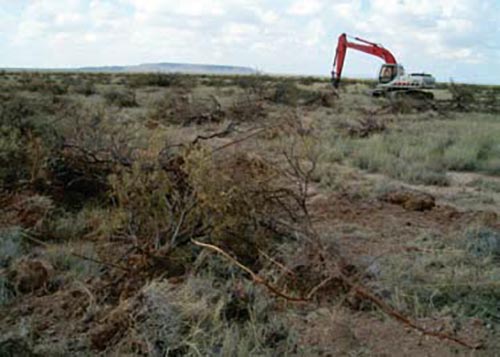
We chose a translocation site to meet the habitat requirements of prairie dogs, and restored the area by clearing more than 200 acres of mesquite. We also mowed the area directly surrounding the release site to help the newly released prairie dogs detect predators.
We released 200 individual prairie dogs over the course of three translocation events. The survival rate of the translocated animals was less than 10 percent. We believe the unexpectedly high rate of loss was due to a number of factors, including stress, unexpected precipitation, potential territorial behavior, and the lack of a pre-existing colony.
The vegetation inventory included measuring woody species occurrence, estimating mean canopy cover, and surveying mesquite plants to document potential herbivory. Sampling was conducted before and after mechanical brush removal and before and after translocation. We found that woody species decreased overall in dominance and frequency after brush removal, and we observed one instance of broken branches on a monitored mesquite plant.
We also conducted visual and burrow surveys to monitor the prairie dogs after translocation. The results of this study were used to develop a habitat model for the prairie dog in the Trans-Pecos — a total of 385,324 acres of “best habitat” were determined available for colonization.
Restoring habitat for translocation of a native population of prairie dogs within their historic range can potentially aid in the restoration of an ecosystem, and future research on an established black-tailed prairie dog population would enable researchers to assess and evaluate the impacts of this keystone species in a desert grassland ecosystem.