
Our Work
Field-based research, education, and partnerships advancing wildlife conservation and resilient landscapes across the Borderlands.
Movement And Social Responses Of Aoudad And Mule Deer To Population Management Efforts
By Andrew Dotray, Justin French, Mark Bell, Carlos Gonzalez, Levi Heffelfinger (TAMK), Shawn Gray (TPWD), and Froylan Hernandez (TPWD)
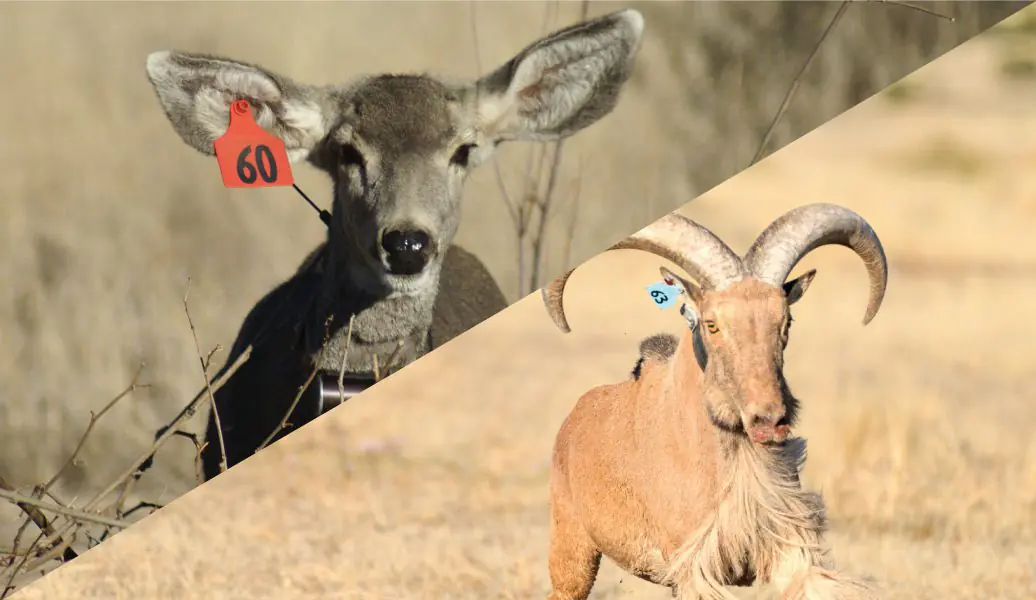
The interactions between non-native aoudad (Ammotragus lervia) and mule deer (Odocoileus hemionus) are poorly understood. However, they likely compete at greater population densities, and mule deer may shift space use to mitigate resource competition. We sought to understand how aoudad population reduction via aerial gunning affects the space use of both species. We predicted that aoudad would shift their ranges to minimize visibility following population reduction.
In April 2023, we captured and collared 40 aoudad and 40 mule deer in the Chinati and Quitman mountain ranges in the Trans-Pecos. To assess aoudad and mule deer response to aoudad reduction, we lethally removed aoudad (n= 7,268) in the Chinati Mountains in August 2024 and June 2025. We estimated monthly space use of both species using Brownian bridge estimators.
We used generalized additive models with a Gamma distribution and log-link to examine the effects of aerial gunning on aoudad range sizes. The top model included a slow decay rate in the effect of aerial gunning on monthly range size (R2 = 6.87). Proportionally, aoudad range sizes shrank by 28% following aerial gunning but returned to pre-gunning sizes within 252 days.
However, wide prediction intervals suggest high variation among individual range sizes and the return rate to pre-gunning averages. Neither aoudad nor mule deer dispersed from the treated area in response to aerial gunning. These results suggest that aoudad reduce movement in response to treatment, and aerial gunning did not displace either species.