Our Work
Field-based research, education, and partnerships advancing wildlife conservation and resilient landscapes across the Borderlands.
Do Release Methods for Desert Bighorn Affect Habitat Utilization?
Taylor S. Daily, Carlos E. Gonzalez, Louis A. Harveson, Warren C. Conway (Texas Tech University), Froylan Hernandez (TPWD)
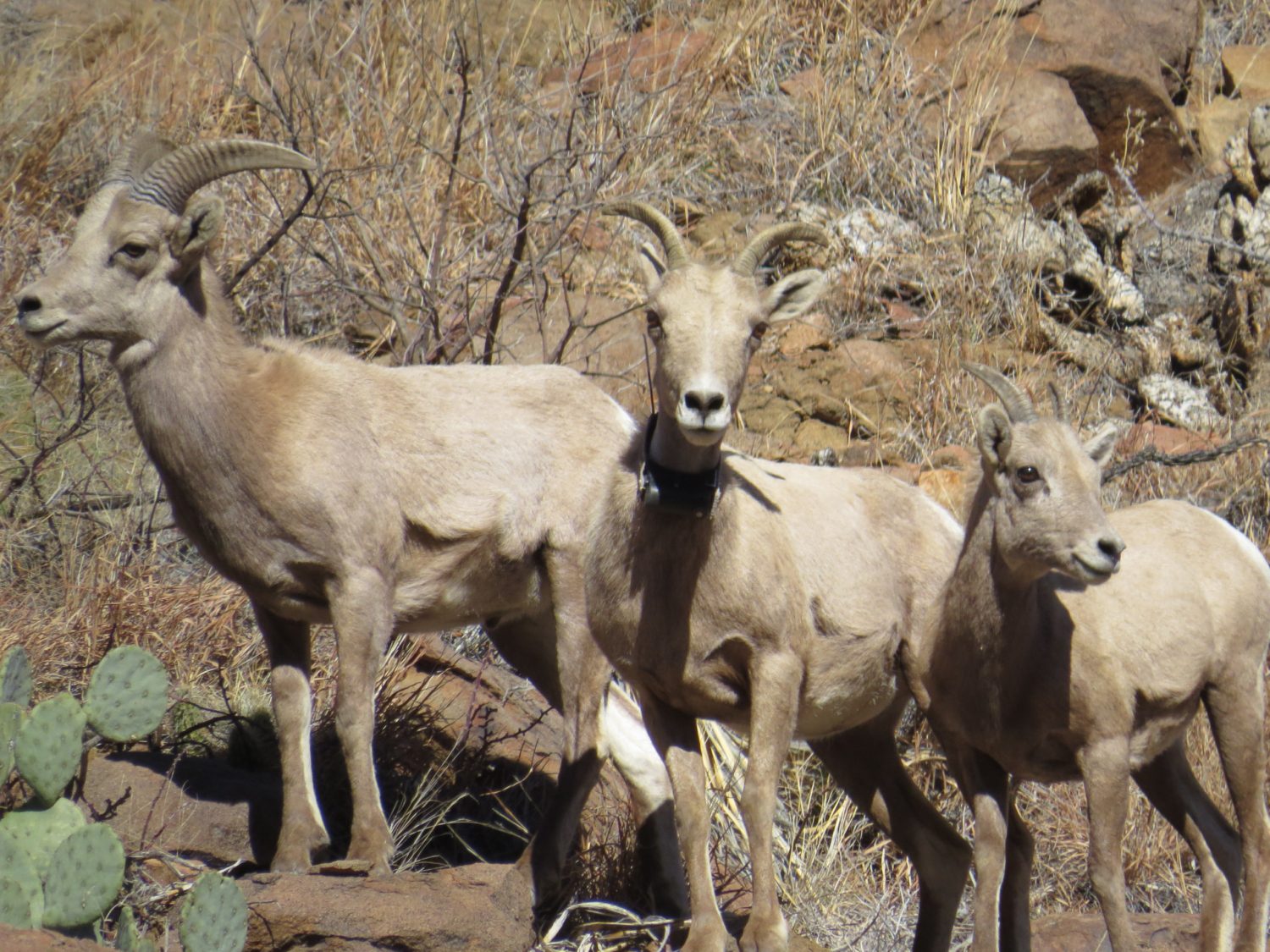
Desert bighorn sheep (O. c. mexicana), a recognized subspecies of bighorn sheep, are native to the deserts of the United States intermountain west and northwestern Mexico. In Texas, they occur throughout the Trans-Pecos eco-region. Once distributed throughout 16 mountain ranges, by the 1960s they were extirpated from Texas due to unregulated hunting, habitat loss, predation, and disease transmission from livestock.
Restoration efforts have been successfully conducted by the Texas Parks and Wildlife Department to increase population numbers of resident (animals that currently populate a region of interest) desert bighorn at Black Gap Wildlife Management Area through translocation. In winter 2017–18, we radio-collared and released 30 resident (8 male, 22 female) and 70 within-state translocated desert bighorn (36 male, 34 female) to Black Gap Wildlife Management Area. Of the 70 bighorns translocated, 28 (12 male, 16 female) were hard released (immediately released onto the landscape) and 42 (24 male, 18 female) were soft released (released into an enclosure before onto the landscape).
Preliminary results show habitat utilization is most correlated with herding behavior (R = 0.411, P = 0.001); however, herding behavior is most explained by release method (R2 = 0.222, P = 0.001), indicating an indirect relationship between release method and desert bighorn habitat utilization. Habitat utilization is influenced less by release type and more by the individuals’ tendency to socially interact in herds. Wildlife managers will be able to use these results to better manage for desert bighorn and ensure their preservation in Texas.
Funding sources: West Texas Club of the Safari Club International, San Antonio Livestock Expo, and Texas Parks and Wildlife Department.