
Our Work
Field-based research, education, and partnerships advancing wildlife conservation and resilient landscapes across the Borderlands.

Identifying Scalable Algorithms For Measuring Brush Impacts On Pronghorn Habitat At Ecoregion Scales
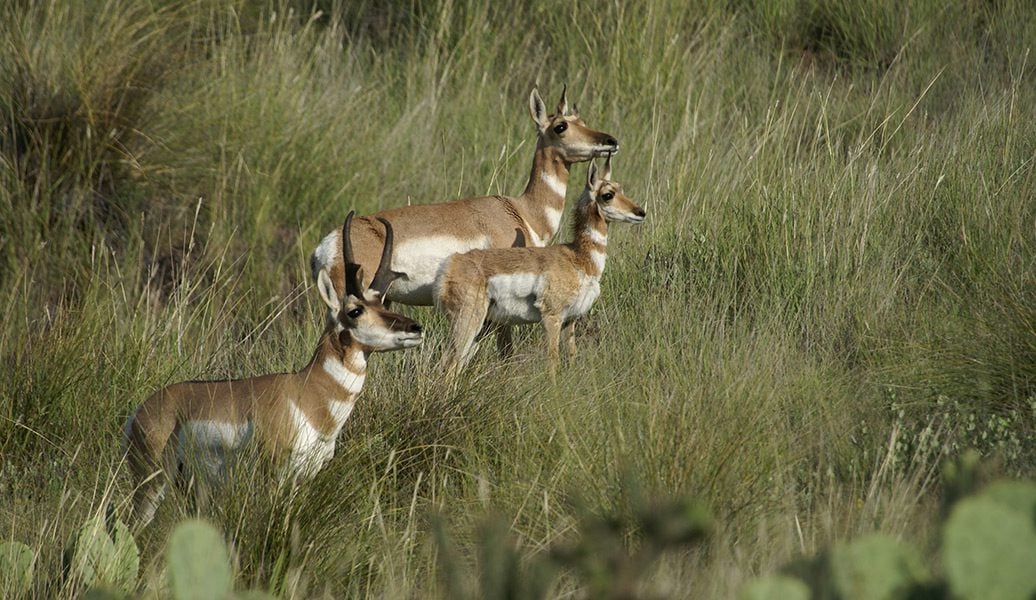
By Halli Lovell, Justin French, Mark Bell, Carlos Gonzalez, Levi Heffelfinger (TAMK), and Shawn Gray (TPWD)
Brush encroachment degrades North American rangelands, severely impacting habitat quality for numerous wildlife populations. Managers frequently attribute pronghorn (Antilocapra americana) declines in the Trans-Pecos region to brush encroachment, but there is no objective assessment of the degree or spatial distribution of these impacts.
Recent advances in Landsat satellite technology now allow for the detection of regional-scale changes in vegetation abundance and distribution, offering capabilities not addressed in existing frameworks and considerable gains in computational efficiency. This study aims to evaluate the accuracy and precision of leveraging vegetation phenology information, rather than instantaneous spectral information, to predict brush canopy cover at landscape scales, and assess brush impacts on pronghorn habitat.
Specifically, we predict that pixels with slower rates of vegetation change and reduced range of vegetation productivity will contain more extensive brush cover. We used functional PCA and zero-inflated gamma models to evaluate these predictions. We found our hypothesis held for predicting the presence of brush (exp(b) = 1.62, SE = 2.86, p = 0.004), but other aspects of phenology predicted the degree of canopy cover (exp(b) = 7.28, SE = 1.07, p = 0.005), given brush was present. By incorporating landscape-wide predictions into models of pronghorn habitat selection, we will estimate the effect of brush canopy cover on habitat quality and determine the impact of brush control efforts. Ultimately, these results will guide spatial prioritization and subsequent monitoring of brush treatments to improve pronghorn habitat.