Research Lightning Round
Trans-Pecos Wildlife Conference 2026
Aug. 6, 10:00 am Session
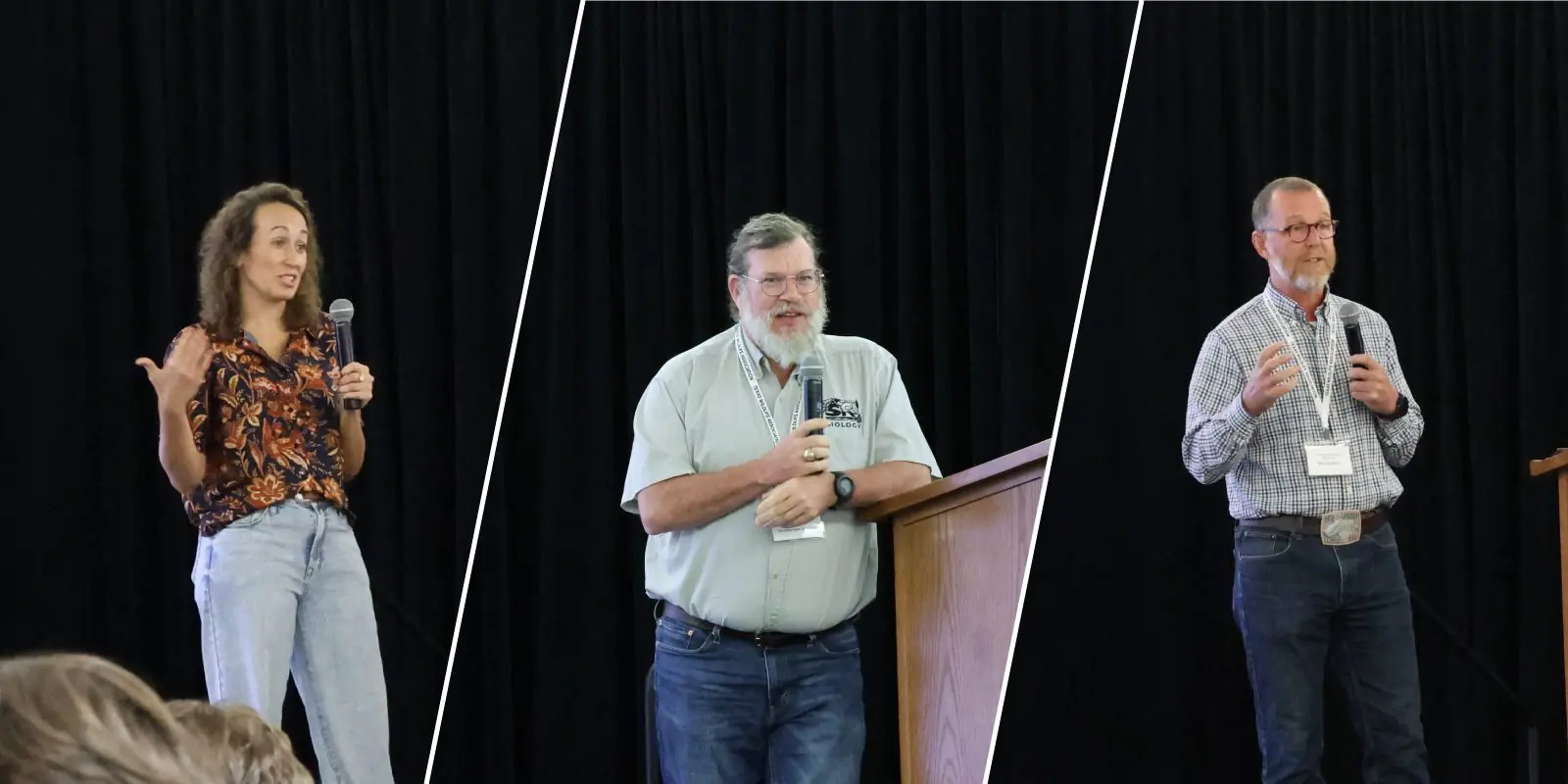
A staple of conferences at Sul Ross State University, research lightning rounds give scientists a chance to share a snapshot of their work in a fast-paced format. At the 2026 Trans-Pecos Wildlife Conference, three researchers used their brief turns at the microphone to cover a lot of ground—and water—from the springs and rivers of West Texas to riparian restoration and migratory birds that connect the region to landscapes across North America.
Connected by Water: Linking Springs, Rivers, Wildlife, and People
For Dr. Kelbi DeLaune, understanding West Texas begins with water.
“Everything we care about, our communities, wildlife, ranching, our personal and community health and well-being, they’re all really tied to water,” she said. “We cannot exist here without water.”
DeLaune, a research scientist with the Meadows Research Institute for West Texas Water at Sul Ross State University, studies aquatic ecosystems and the connections among groundwater, springs, rivers, wildlife, and people. Her research explores topics including water quantity and quality and how changes such as drought, groundwater pumping, and invasive species can affect desert ecosystems.
Those changes can have outsized consequences in a region where a single spring may support species found nowhere else.
“We cannot protect or preserve if we don’t understand the water quality and quantity that we have to work with and manage,” she said.
DeLaune described work underway through the Meadows Research Institute to better understand those systems and develop practical solutions. That includes the San Solomon Springs Collaborative, which brings together landowners, scientists and community members to better understand spring flows, recharge, and what can be done to sustain them.
The approach extends beyond individual springs or rivers. Delaune said a core theme of her research is understanding how everything is connected and bringing an interdisciplinary approach to the issues facing West Texas water.
An Update of Three Saltcedar Biocontrols Along the Rio Grande and Pecos Rivers
Dr. Christopher Ritzi has spent two decades watching some very small insects take on a very big problem.
Saltcedar was introduced with good intentions as an erosion-control plant but eventually came to dominate riparian areas across much of the West. Ritzi explained that dense stands can reduce plant diversity, followed by declines in insect, bird, and mammal diversity.
“The goal was to knock saltcedar back, allow other things to come in its place, reestablish a greater degree of biodiversity, and let the ecosystem go back to the way it was,” he said.
Beginning in 2006, Ritzi became involved in efforts to establish saltcedar leaf beetles as a biological control along the Rio Grande. After their release, beetle populations expanded dramatically, at times moving across the landscape in waves and completely defoliating saltcedar.
But Ritzi emphasized that success does not mean eliminating the plant.
“A good biocontrol is not an eradication. It’s a control system,” he said. “The whole idea is that this will be continually doing long-term management.”
Today, the once-enormous beetle populations have declined, but Ritzi said they continue to produce localized defoliation along the Rio Grande. Two other insects, tamarisk scale and the splendid tamarisk weevil, are also contributing to saltcedar control.
Along the Pecos River, efforts to establish saltcedar leaf beetles have been less successful. Ritzi and partners are exploring another reintroduction while continuing to monitor the other biocontrol insects already present.
“We’re still getting active biocontrol,” he said, “and hopefully getting saltcedar to be a little bit less dominant and give other things a chance to really increase our biodiversity and the health of our ecosystem as a whole.”
Ritzi credited the partners that have supported the work over the years, including Friends of the Pecos, the Meadows Research Institute for West Texas Water, Sul Ross State University, and the Rio Grande Research Center.
Moving Conservation and Management Forward: a Perspective Gained from a Decade-Plus of Research
For Dr. Daniel Collins, the lightning round offered an opportunity to introduce himself to the Trans-Pecos conservation community and explain how a career studying migratory game birds shaped the research he is now bringing back to Sul Ross.
Collins earned his master’s degree at Sul Ross before spending 17 years with the U.S. Fish and Wildlife Service, working across the West on migratory game bird management. Those experiences, he said, reinforced the importance of research that helps managers make decisions.
“Large landscapes need groups that work together and that answer questions,” Collins said. “It really took me from being sort of basic science to applied science.”
Now back at Sul Ross, Collins is involved in projects ranging from sandhill cranes and northern pintails to Mexican ducks and redheads. Locally, he and Dr. Antonio Cantu are working on a Balmorhea wetland initiative that includes Mexican duck research and active management of wetlands in the area.
Other projects stretch well beyond West Texas, reflecting the reality that migratory birds connect distant landscapes. One project will mark redheads in Montana with GPS units and follow them wherever they travel. Collins noted that the Laguna Madre is thought to winter 80 percent of the continental redhead population, making it particularly important to understand how the birds use that system.
That geographic reach is intentional.
“When you think about migratory game birds, or just migratory birds in general, we need to actually look at their annual cycle,” Collins said. “If we can work in North Dakota for a species like pintail that overwinter here in Texas, we’re gonna go where those birds can be caught, can be marked, and studied to answer questions.”
Sponsors and Organizing Partners
The 2026 Trans-Pecos Wildlife Conference brought together a collaborative team of organizing partners, including the Borderlands Research Institute at Sul Ross State University, Texas Wildlife Association, and Texas Parks and Wildlife Department.
The conference was made possible through the generous support of our sponsors: Dixon Water Foundation, ConocoPhillips, Corteva Agriscience, Alligare, No Big Bend Wall, and the Center for Big Bend Studies. We sincerely thank our sponsors for their commitment to advancing wildlife conservation and stewardship in the Trans-Pecos region.