Our Work
Field-based research, education, and partnerships advancing wildlife conservation and resilient landscapes across the Borderlands.

Pronghorn Movements Following Restoration

By Justin K. Hoffman, Patricia M. Harveson, Bonnie J. Warnock, Shawn S. Gray (TPWD), and Louis A. Harveson
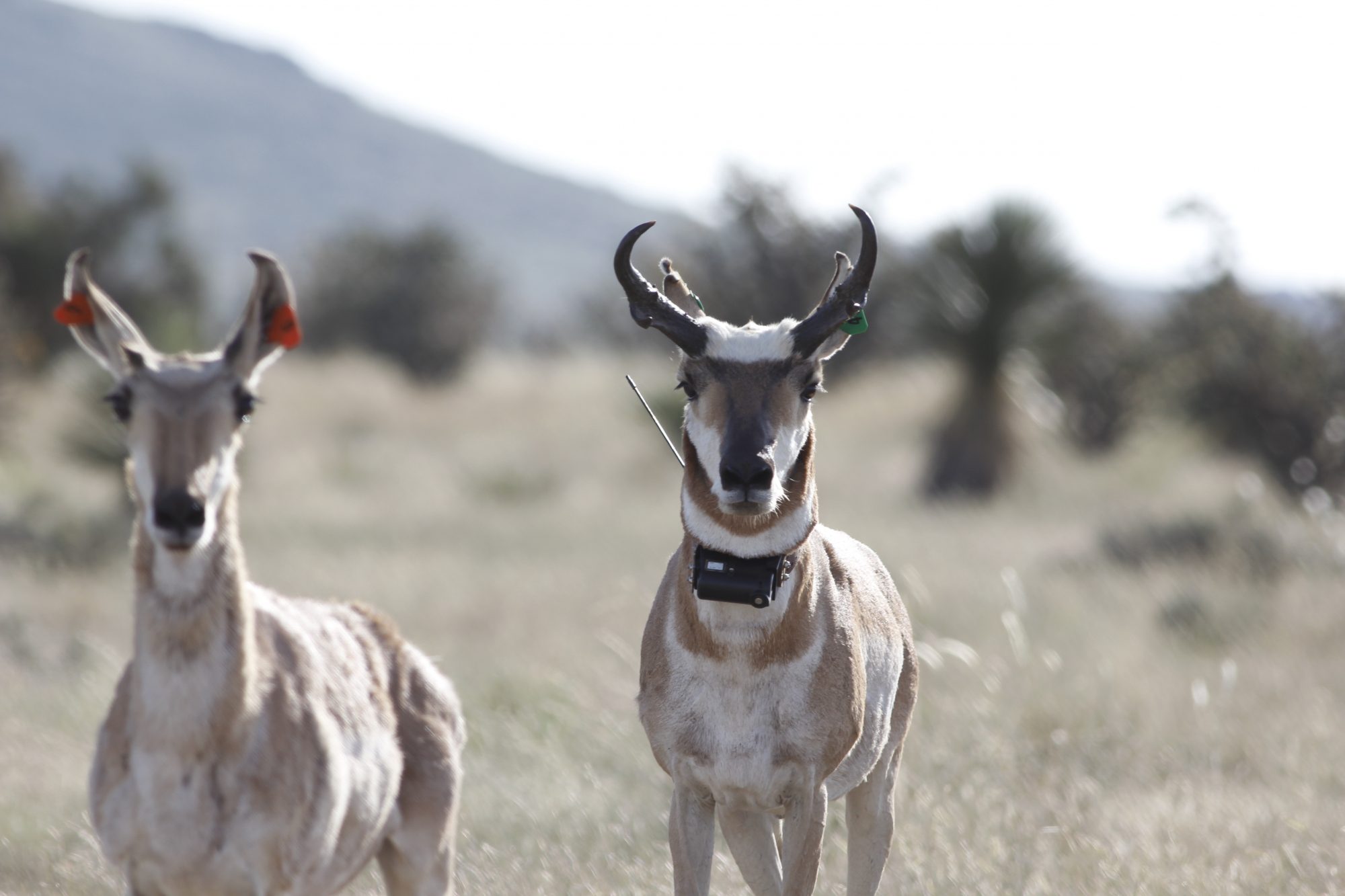
When evaluating the success of any wildlife restoration effort, survivability is typically the top priority during assessment. However, understanding the movements and post-release behavior of translocated animals and how they change over time are important aspects for assessing the success of translocations and improving future efforts. We assessed the behaviors and movements of translocated pronghorn by equipping 28 (15 females, 13 males) pronghorn with GPS radio collars, designed to obtain 1 location/hour with a 300-day battery life.

Mean distances of locations in relation to the initial release site were measured for dispersal. Within 24 hours of release, pronghorn dispersed from 3.6-10 mi. As time progressed, mean distances gradually increased, but individuals responded differently. The differences in these values suggest habitat and resource availability, fences, resident pronghorn, and other factors influenced the degree of site fidelity exhibited.
Pronghorn moved an average of 814 ft/hr. Diurnal movement rates (1,345 ft/hr) were greater than nocturnal movement rates (791 ft/hr). Range use areas were measured by utilizing 100% Minimum Convex Polygon (MCP) and Fixed Kernel Density Estimator (KDE) at both 95% and 50%. Overall range use areas for 100% MCP were 9,521 acres, with KDE 95% and 50% being 14,085 and 2,718 acres, respectively. Range use areas generally decreased from month to month. Translocated pronghorn selected areas of disturbance or low-lying areas (e.g., swales and draws) that contained deeper, moister soils with higher forb availability.
Scatter plots of radioed pronghorn also revealed some interesting data. Movement patterns were much larger than anticipated, and many pronghorn were not able to navigate the existing fences. We speculate that the extensive fencing system may have contributed to the death of several pronghorn. During a severe drought in the 1960s, net-wire fences in the Trans-Pecos prevented a pronghorn herd from moving into areas with available forage. That population subsequently experienced a 60% die-off due to malnutrition.
This information will allow wildlife managers in the future to understand how pronghorn initially adapt to a new environment and assist in improving monitoring and site preparation efforts.